 Eight years ago, then-executive vice president of Embraer Executive Jets Luis Carlos Affonso surprised NBAA show attendees by unveiling concepts for two completely new jets, dubbed mid-light and mid-size; a year later these became the Embraer Legacy 450 and the Embraer Legacy 500. The new jets not only signaled the company’s efforts to build a larger presence in the business jet market but also a commitment to fly-by-wire flight control technology that is not available in jets in that class.
At the time, it was unlikely that anyone at Embraer knew that Cessna designers would soon begin sketching the design for a flat-floor cabin jet–the Latitude–that would prove to be a direct competitor to the Legacy 450. And the Embraer prognosticators would not learn until years later that one of the competing midsize jets–the Learjet 85–would eventually suffer a program pause that many in the industry believe will never be un-paused.
What Embraer leaders did see was an opportunity to carve out new niches in the market with two business jets that share 95 percent commonality, differing only in cabin length and range, and that have fly-by-wire (FBW) flight controls, the latest Pro Line Fusion avionics from Rockwell Collins, Honeywell Ovation Select cabin management system and Honeywell HTF7500E engines.
 The Legacy 500 (officially EMB-550) received Brazilian ANAC certification last August and was certified by the FAA last October and by the EASA in December. The Legacy 450 is slated to enter service by year-end.
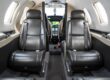
At first glance, the Legacy 500 looks large, and in many ways it is. The flat floor, for example, adds a spacious feel to the 826-cu-ft cabin, which is larger than that of the Citation Sovereign+ at 620 cu ft but smaller than the Challenger 300/350 at 860 cu ft and the Gulfstream G280, the largest at 935 cu ft. Of the three competitors, only the Challenger has a flat-floor cabin, and this feature seems to be gaining traction as a popular differentiator. The Challenger and G280 are the only jets with a taller cabin height than the 72 inches of the Legacy 450/500, with the Challenger offering one more inch and the G280 three more inches.
The Legacy 500’s Pro Line Fusion-equipped flight deck is not only roomy but also uncluttered and logically laid out to address sound human-factors principles. Sidestick controls help maximize cockpit space, too: removing the bulky yokes saves space, weight and mechanical complexity and gives free rein to seat designers who no longer have to cut a channel in the front of the seat to accommodate a yoke’s aft movement. The sidesticks also open room for stowable tables in front of each pilot.
Embraer designers elected to eliminate a steering tiller to save space and not interfere with the sidesticks. The nosewheel steering mechanism is electro-hydraulic, but also steer-by-wire, and can swivel 62 degrees either side at slow speeds, narrowing to just 4 degrees at high speeds. Cockpit windows are extra large and provide excellent visibility. The windshields are replaceable from outside the cockpit, so no interior panels need to be removed for windshield replacement, which should save hours of labor.
The 110-cu-ft external baggage compartment is quite high off the ground, but accessible via an optional (but free) ladder that fits neatly into the door. Optional heating is available for the unpressurized baggage compartment. An additional 45 cu ft of baggage space is available inside the cabin, just aft of the lavatory, and this is plenty of space to handle carry-on luggage that passengers might need to access during flight.
This article was originally posted on AINOnline.com