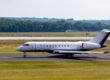
 Understanding your jet’s hangar costs involves more than just knowing the rent for the space where your aircraft is stored. While it might seem straightforward, hangar costs are influenced by factors such as airport location, space requirements, and whether you choose to lease, rent, or own the facility. Additionally, there are hidden costs related to utilities, maintenance, and potential insurance needs, especially if you have multiple aircraft. Understanding these complexities ensures you can effectively manage and budget for your jet’s hangar costs while optimizing your aviation operations.
When thinking of the major fixed costs associated with aircraft ownership, hangar costs seem simple at first glance, but have many nuances…
We all understand that the hangar is the location at the aircraft’s home base where the plane is stored. Since we’re looking at turbine-powered business aircraft, this is almost always a closed building, often containing some office space for the flight operations and a waiting area for passengers.
The cost of such a facility is related to the amount of space you need. The simple fact is that larger aircraft require greater space, and thus the cost is higher to hangar them. But that’s where the simplicity of hangar costs end…
When comparing hangar costs, there are other factors that you should consider, such as the airport location, the method of acquisition (are you looking to lease or own the hangar?), and various other extenuating circumstances.
The Cost of Business Aircraft Hangar Location
A hangar is real estate and is therefore all about location, location, location! Popular airports located in or close to major metropolitan areas have limited space relative to their high demand.
At the airline hubs, for example, General Aviation is allocated very little room and often has limited transient parking, so many areas have General Aviation airports located separately from the airline hubs. But because of the convenience of these locations, they are in high demand, driving up your jet’s hangar costs.
Given the transient traffic, these airports often have several major FBO operators offering overnight ramp and hangar space, which can limit the options for home-basing of aircraft. Further adding to demand for hangar space is the desirability of the maintenance facilities that are located there.
The surrounding communities are usually built up around these airports leaving little- to-no room to expand land operations. Thus, this category of airport commands the highest hangar fees.
Operators whose budget cannot stretch to the cost of hangaring at one of these locations should look at airport locations that are further away but still offer convenient access.
Business Aircraft Hangars: Buy or Lease?
Another differentiation in evaluating hangar costs is leasing, renting or buying. Many airports are owned by their local municipalities or airport authorities. Land at these airports may not be available for private ownership unless the airport is actively seeking development.
It is common for the airport authority to lease the land to be developed, which may enable you to build your own hangar on the leased land. Thus, you may have a land-lease to budget for in addition to the mortgage expense for the building.
A significant part of owning your own hangar includes budgeting for utilities, tax, airport fees, and the maintenance and upkeep of the building.
For those who own their hangar, it may be possible to have their own fuel storage farm, too. Buying your own fuel in bulk may save some costs, ultimately. On the flipside, however, this can also confuse your calculation/budget for the variable cost of fuel.
The cost of running your fuel farm (including storage tanks, fuel truck, and refueling employees) would likely be a fixed cost, while the cost per gallon of fuel purchased in bulk is the variable cost. When an operator says they pay $2.50 per gallon for fuel at home, is that the total cost of getting the fuel into the aircraft?
Another way is to lease hangar space from an FBO or Management Company. This space may be shared with other operator’s aircraft. While this reduces the total rent, it also adds ground handling risk in that your aircraft is being moved to allow other aircraft to enter and exit the hangar.
If you have a managed aircraft, the hangar expenses should be clearly defined in your agreement as to what is included and what will be billed separately. And be sure to work with your insurance broker to review the coverages of your aircraft on the ground, for both the hull and liability.
Who assumes liability for “hangar rash” if your aircraft is damaged while towing it into or out of the hangar, for example? What about in a worst case scenario? In February 2010 a massive snowstorm caused three hangar roofs to collapse at Dulles Jet Center in Washington, DC, and three global business jets were among the 14 aircraft to be significantly damaged. Though extremely rare, insurance needs to be in place to cover the potential losses.
Multi-Aircraft Hangar Costs
The last consideration in hangar costing is for the multi-aircraft operator. If you have a single hangar with multiple aircraft, how do you allocate the costs? If the aircraft are of the same make and model, the cost can be divided equally. But if, for example, if you have a single-engine Light Jet, a twin-engine Mid-Size Jet and a Large Cabin Jet, allocating one-third of the hangar cost to each (especially if a fuel farm is incorporated) is not correct.
One way is to allocate the cost by the approximate square footage of hangar allocated to each aircraft – but that calculation becomes rather more complex when a fuel farm is installed and fuel usage is included.
In the aviation department budget, ‘hangar cost’ is often a single line item. But as we’ve demonstrated, calculating this item often involves the consideration and allocation of costs.
Nevertheless, unless you move often, this calculation is likely to be more of a one-time exercise with the setting up of the appropriate cost categories.
Original article published on avbuyer.com